ServicesReverse Osmosis
Reverse Osmosis Systems in Marina del Rey
We install under-sink reverse osmosis systems that send cleaner drinking and cooking water to a dedicated faucet in your kitchen. Before anything is installed, you get a written quote that names each filter stage, the tank, the faucet and any add-ons.
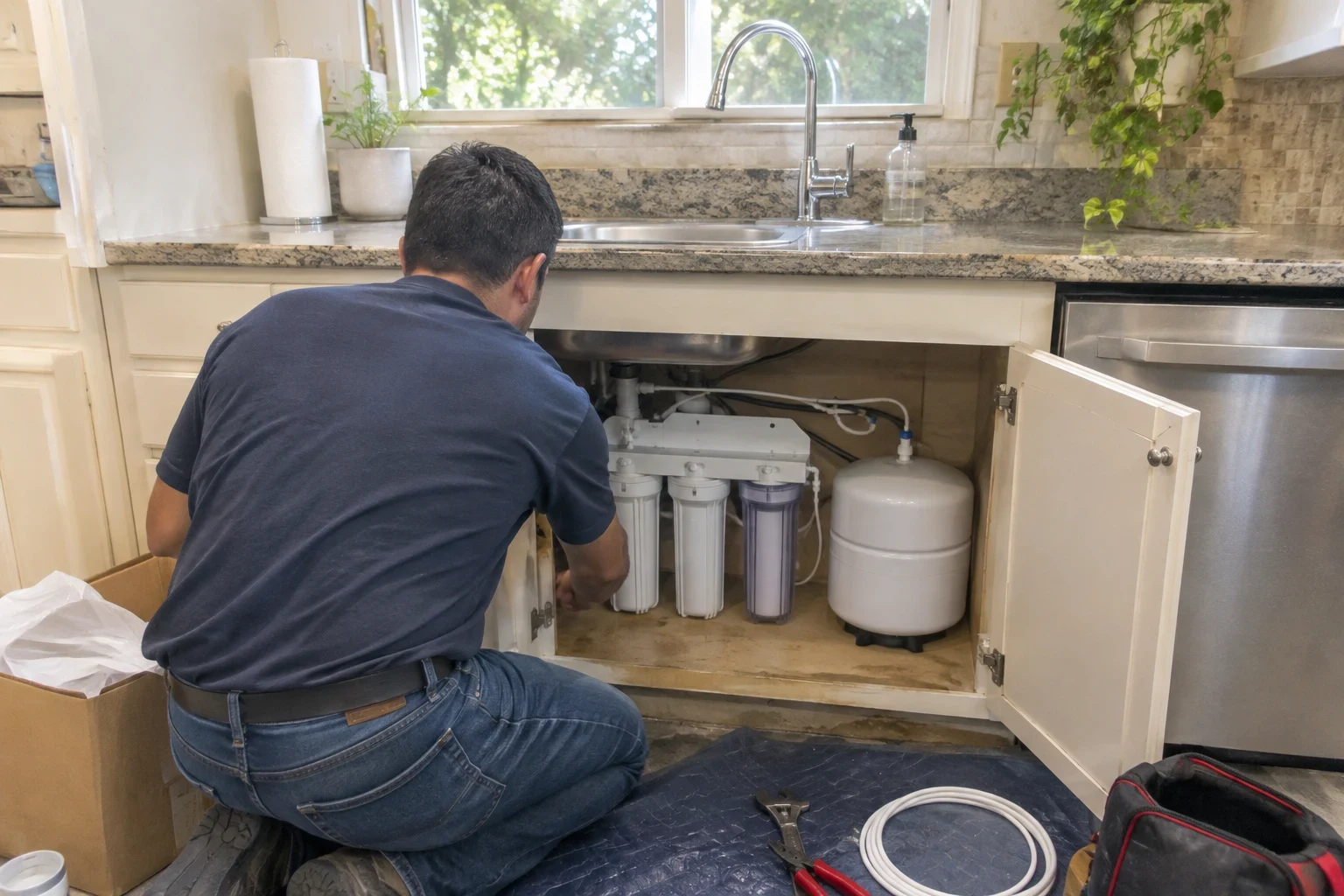
What Reverse Osmosis Does at Your Kitchen Sink
Inside an RO system, cold water is forced against a semipermeable membrane, a tightly wound sheet of thin-film composite. Water molecules pass through it, while most dissolved solids are turned away, including minerals, lead, nitrate, arsenic and many trace contaminants. That rejected stream is flushed to the drain, and the purified water builds up in a small pressurized tank beneath the sink.
The membrane is the heart of the system, and it is also the most delicate part. A sediment prefilter traps sand and flakes of pipe scale before they can foul it. A carbon block prefilter then removes chlorine and chloramine, both of which slowly degrade the membrane material. After the tank, a carbon polishing filter catches any taste the water picks up while it sits.
RO is the right tool when the goal is better water from one tap: the glass you pour, the kettle you fill and the pot you boil pasta in. For treated water at more fixtures in your home, our City Water Filtration and Dual Tank Water Filtration pages cover those systems.
What Your Installation Includes
- Multi-stage filter housing
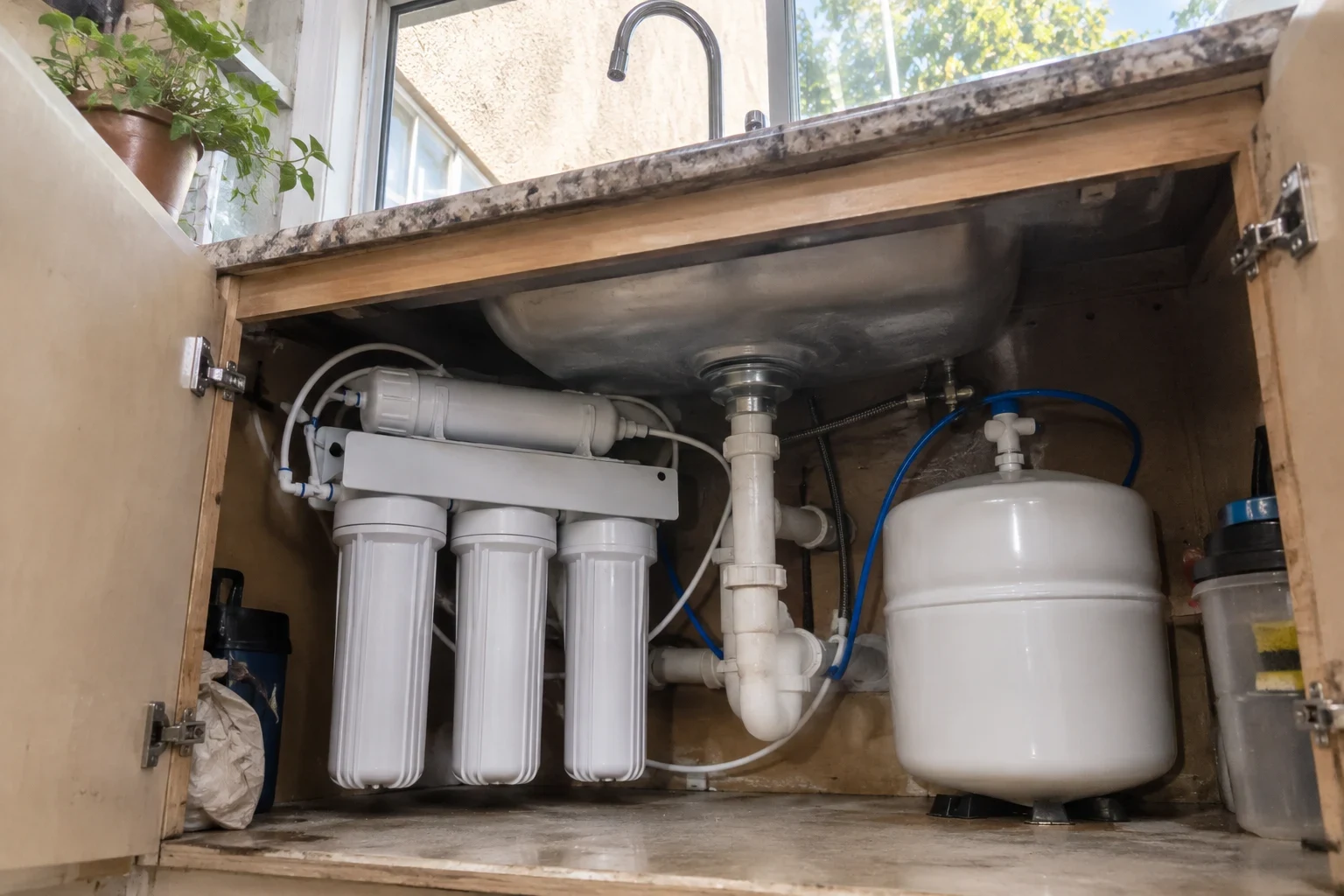
- We mount the sediment prefilter, carbon prefilter, RO membrane and post filter on a bracket inside the sink cabinet, set so each cartridge can be twisted out without pulling the system apart.
- Feed water connection
- An adapter tees into your cold water supply below the angle stop, so your main kitchen faucet keeps working exactly as it did.
- Drain saddle and air gap
- The brine line ties into the drain above the trap with a saddle clamp. Positioning it there keeps drain water from siphoning back toward the membrane.
- Storage tank
- The tank holds filtered water under air pressure from an internal bladder. We check the precharge before filling it, because a low air charge means weak flow at the faucet.
- Dedicated drinking faucet
- The RO faucet goes in an existing sprayer or soap hole when one is free, or in a new hole drilled through the counter or sink deck.
- Cleanup and walkthrough
- We clear the cabinet, wipe up, and show you where each cartridge sits and when it is due.
When Under-Sink RO Is Worth Adding
Bottled water is on every grocery list
Hauling cases of water home each week adds up in money, storage space and plastic. A dedicated RO faucet gives you filtered water on tap, so those cases can come off the list.
Coffee and tea taste flat or chemical
Chlorine or chloramine from treatment can come through in hot drinks. The carbon stages in an RO system take that out before the water reaches your cup.
White crust on kettles and glasses
Much of the water piped into the Los Angeles area carries a heavy dissolved mineral load. RO removes most of it from your drinking water, so kettles and coffee makers scale up far more slowly.
Older plumbing in the house
Homes plumbed before the mid-1980s may have lead solder at copper joints. An RO membrane reduces lead at the tap where you fill glasses and pots.
Cloudy ice cubes
Dissolved solids and trapped gases make ice cloudy and give it an off taste. A line from the RO system to the refrigerator fixes both.
What Moves the Price of an RO System
Our free install (we cover the cost) means the number you see centers on the equipment itself. The system design, your water pressure and the add-ons you choose are what change it. Each one is spelled out on the written quote so you can see why it is there.
Stage count and membrane output
Most kitchens do well with four or five filtration stages. A membrane rated for higher daily output costs more, but it refills the tank faster when a large household draws heavily.
Tank or tankless design
Tankless units free up cabinet space and deliver water on demand, but they use a pump and electrical outlet and sit at a different price point.
Incoming water pressure
Membranes work best with steady supply pressure. When pressure is low, a booster pump or permeate pump keeps production and flow at the faucet where they should be.
Add-ons
A refrigerator and ice maker line, a remineralization cartridge or an upgraded faucet finish each add parts to the scope.
How the Work Runs, From Call to First Glass
- 1
A phone conversation first
You tell us about your sink, cabinet space, counter material and whether you want the refrigerator connected. We ask about any garbage disposal or pull-out trash, since both compete for room under the sink.
- 2
A written quote before any work
We send the scope in writing: the system model, each filter stage, tank size, faucet finish and any add-ons such as a booster pump. What is on the quote is what gets installed, with no parts added on the day.
- 3
Installation in your kitchen
We shut off the cold supply, fit the feed adapter and drain saddle, mount the housing and tank, set the faucet, and run all tubing with clean bends so nothing kinks. Most kitchens need a few hours.
- 4
Flushing and leak checks
New carbon and membrane cartridges need to be flushed before use, so we run and drain the first tanks of water. We check every push-fit connection under pressure before closing the cabinet.
Common Questions About Reverse Osmosis
How much water goes to the drain with RO?
All RO systems send part of the water away to rinse the membrane. How much depends on the membrane, the pressure at your tap and the way the system is built. A permeate pump or a more efficient membrane cuts that waste a good deal. Your quote shows the expected ratio for the model you pick, so you know it in advance.
Will RO water taste flat?
Taking out minerals shifts the taste, and some people pick up on it early on. A remineralization cartridge placed after the membrane puts a little calcium and magnesium back in. We can add one if that taste suits you better.
When do the cartridges need replacing?
Expect to change the sediment and carbon cartridges and the post filter about every 6 to 12 months. The membrane holds up longer, typically 2 to 3 years. Heavy use or a sandy supply shortens those intervals. We give you each cartridge's part number so reordering is quick.
Will RO fit under a sink that has a garbage disposal?
Most kitchens have room. The filter bracket mounts on a cabinet side wall, and the storage tank sits in a back corner or next to the disposal. If the cabinet is truly too tight, a tankless unit fixes the problem, and we tell you that on the phone before anything is priced on paper.
Why does the RO faucet run slower than the main tap?
The RO faucet draws from the storage tank, and the tank's air charge moves the water instead of full line pressure. With the right charge, a glass or pot still fills without much waiting. When flow tapers off over time, a low tank precharge or a clogged post filter is the usual culprit.
See Every Part in Writing First
Give us a sense of your sink cabinet and how your household uses its drinking water. Before we touch a fitting, the system, each filter stage and any extras are listed on a written quote.