ServicesDual Tank Water Filtration
Marina del Rey Dual Tank Water Filtration
With a dual tank system, two media tanks sit on the line supplying your house, so filtered water reaches every faucet, shower and appliance. We match the tanks to your flow, list each part on a written quote, and do the install with no surprise add-ons.
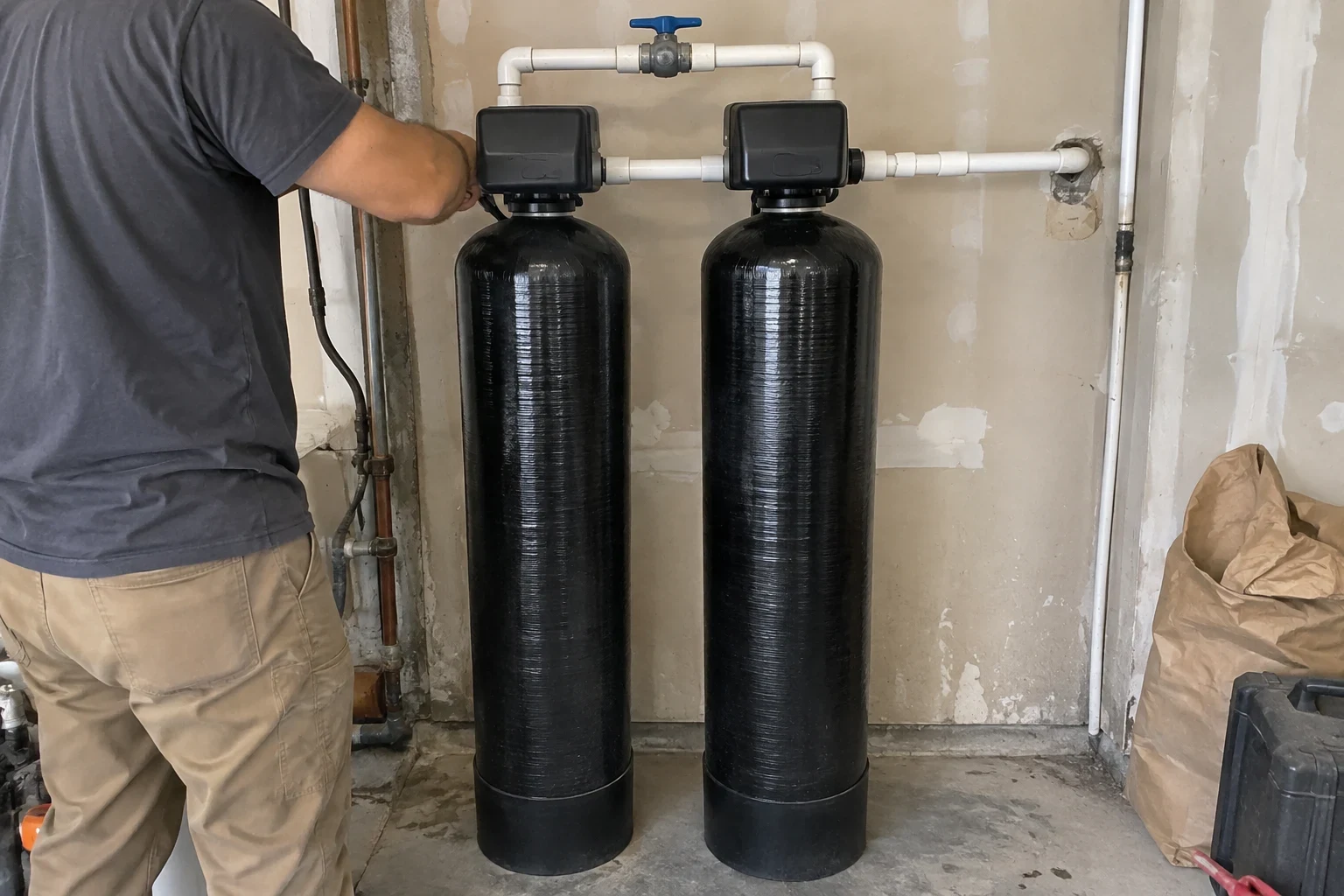
What a Dual Tank System Does
A dual tank system runs your incoming water through two pressure vessels in series. The first tank usually holds catalytic carbon, a media built to break down chlorine and chloramine, the disinfectants that give tap water its pool smell and flat taste. The second tank holds a media chosen for what your water still needs after that, most often scale control so minerals do less damage to fixtures and your water heater.
Splitting the work across two tanks matters. Each media gets its own contact time instead of being mixed and compromised, and each tank can be sized or replaced on its own schedule. Carbon wears out at a different rate than scale media, so you are not throwing away good media to refresh the part that is spent.
It is the right call when the problem shows up at every tap, not just the kitchen. If you mainly want better drinking and cooking water, an under-sink reverse osmosis unit may be the simpler fix, and we will tell you so.
What the Installation Includes
Flow sizing
We count bathrooms, check your main line size and measure pressure. Tank diameter and media volume are matched to your peak flow so showers do not lose pressure when the dishwasher runs.
Two media tanks
A carbon tank for chlorine and chloramine taste and odor, plus a second tank with media picked for your water. Both medias and their volumes are named in the scope we hand you.
Bypass valve
A bypass lets you send water around the tanks during service or a media change. Your home keeps water while the system is offline.
Cut-in at the main line
We tie the system into the line after your shutoff, using fittings rated for potable water. Most installs go near where the line enters the house or in the garage.
Startup and flush
Fresh carbon sheds fine black particles when it first gets wet. We rinse each tank out to a drain and keep it flowing until no more fines show, and only after that do we let filtered water reach your faucets.
Walk-through
Before we leave, we show you the bypass, the shutoff and what maintenance looks like.
Signs Your Home Could Use Two Tanks
Chlorine smell in the shower
Hot water releases disinfectant odor into steam. If you smell it in the bathroom, a single pitcher filter in the kitchen is not reaching the problem.
White crust on fixtures
Chalky rings on faucets, showerheads and glass doors are mineral scale. The same scale forms inside your water heater and on dishwasher elements where you cannot see it.
Spotted dishes and glassware
Water spots left after a full cycle point to dissolved minerals drying on the surface.
Cartridge filters clogging fast
Small housings sized for one faucet are not built for whole-house flow. If you are swapping cartridges often, larger media tanks are usually the better fit.
Low pressure after filtering
An undersized filter restricts flow. Properly sized tanks pass your peak demand with little pressure drop.
How a Dual Tank Job Runs
- 1
Phone conversation
You tell us what you are noticing and about your home. We ask about bathrooms, where your main line is and what you have tried so far.
- 2
On-site look
We check the line location, pipe material, pressure and the space for two tanks. We also confirm drain and power access if the valve you choose needs them.
- 3
Written quote
You get the scope in writing: tank sizes, media, valve, fittings and where everything goes. If something about your plumbing could change the job, it is listed before we start.
- 4
Install day
We close the main shutoff, cut in the bypass and tanks, then fill and flush the media. Your taps will be dry while the line is open, and we give you an estimate of that window before we turn the valve.
- 5
Final checks
We pressure-test every joint for leaks, run several fixtures at once to confirm flow, and clean up the work area.
What Moves the Price
Our offer is free install (we cover the cost), so the price you see is mostly the equipment. What changes it is how much water your home uses and what the second tank needs to do. Every factor below is spelled out in your written quote.
- Tank size
- More bathrooms and higher peak flow call for larger tanks and more media. Bigger vessels also mean longer media life.
- Media choice
- Catalytic carbon for chloramine costs more than standard carbon. The second tank's media depends on whether scale or something else is the main concern.
- Control valve
- A simple in-and-out head costs less than a valve that backwashes on a schedule. We explain which your water needs and why.
- Line location and pipe material
- An exterior main line exposed to coastal air may need an enclosure or cover for the equipment. Older galvanized pipe can need extra fittings to tie in cleanly.
Questions About Dual Tank Systems
Something not covered here? (310) 526-9815
Why use two tanks rather than one mixed tank?
Blending media in one bed weakens both. Carbon needs time in contact with the water to break down chloramine, and scale media performs best once the water is already free of disinfectant. Separate tanks let each media work properly and be changed when it is spent.
Will the tanks make my showers weaker?
Not if the vessels are sized to your demand. A media bed resists more as flow rises, so a tank too small for your peak use is what leaves a shower short. We measure static pressure and count fixtures first, then choose a tank diameter that keeps the drop small.
How long before the media needs changing?
Two things set the timing: the amount of media in each tank and the gallons your home pushes through it every day. Carbon is consumed as it works, so a larger tank lasts longer between changes. The expected interval goes into the written scope you receive before install.
Is this enough on its own for drinking water?
It cuts scale and improves taste and odor at every tap. Many homeowners who want another layer of filtration for drinking and cooking also put an under-sink reverse osmosis unit at the kitchen sink.
Where will the tanks sit?
Most often close to where the main line comes into the house, such as the garage or an outside wall. We choose the location during the on-site visit and write it down before any pipe is cut.
Know the Full Scope Before Any Work Starts
Tell us about your home and what you are noticing in your water. We will size the tanks and put every part and price factor in writing.